Cellular compounds and copper complexes
Glutathione
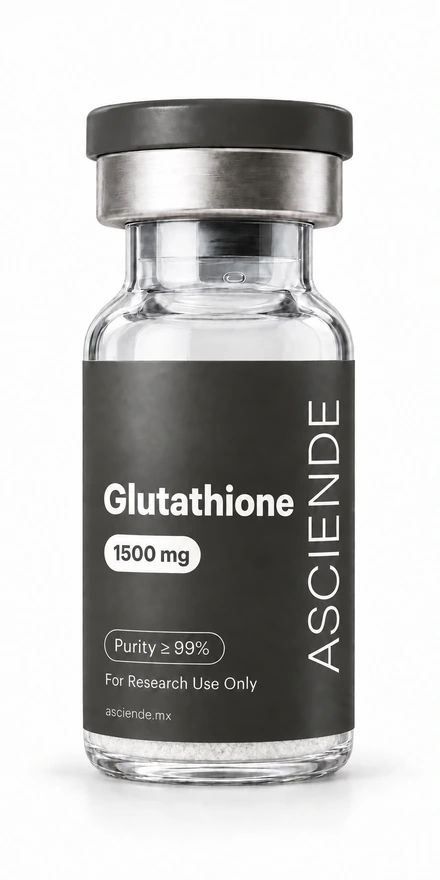
For Glutathione, the declared chemical form matters as much as quantity. Review the technical record and batch documentation; 1500 mg identifies presentation content, not an assay result.
Your selected presentation
Available · SKU GLUT-1500
For laboratory research only. Not for human or veterinary use.
Delivery in MexicoFree from $2,500 MXN. Shipping terms
Shipping protectionReport damage with photos within 24 hours of delivery for one replacement. Conditions
Order summaryPrices in MXN. Cart and checkout are in Spanish; review discounts, shipping and the total before paying.
About this compound
The reduced/oxidized glutathione pair defines a substantial part of the intracellular redox potential in cellular models. The gamma bond protects it from degradation by common peptidases, as described in research literature.
Read the complete research referenceBatch documentation
Ask support which documents are available for the selected variant and batch. Catalog specifications do not establish an individual batch result.
Review documentation informationResearch context & mechanism
The reduced/oxidized glutathione pair defines a substantial part of the intracellular redox potential in cellular models. The gamma bond protects it from degradation by common peptidases, as described in research literature.
Technical specifications
Reference specifications describe the material. They do not replace the analytical results for a specific batch.
- Chemical name
- L-gamma-glutamyl-L-cysteinyl-glycine
- Sequence
- gamma-Glu-Cys-Gly
- Molecular formula
- C10H17N3O6S
- Molecular weight
- 307.32 Da
- CAS number
- 70-18-8
- Form
- Lyophilized powder
- Appearance
- White powder
- Purity specification
- Declared in the batch certificate
- Identity
- Declared in the batch certificate
- Solubility
- Soluble in sterile water and bacteriostatic water
- Storage
- −20 °C, protected from light
- Stability after reconstitution
- Keep refrigerated at 2–8 °C and use within the period defined by the laboratory protocol
Batch documentation
Review documentation for the product and variant you are purchasing. A reference specification, a research publication and an individual batch certificate are different sources. Ask support which documents are available for your chosen variant and batch. No analytical result should be assumed from a catalog specification.
Consult batch certificates How to read documentationLaboratory handling
- Reconstitution
- Laboratory procedure: allow the closed vial to reach room temperature, disinfect the septum and slowly transfer the diluent against the inner wall of the vial. Do not shake; gently swirl the vial until fully dissolved. Record the volume, diluent and date in the batch log.
- Storage
- Sealed vial of lyophilized material: store at −20 °C, protected from light and moisture. Avoid repeated freeze-thaw cycles of reconstituted material; aliquot when the experimental design permits.
- Protective equipment
- Handle in a clean work area with a lab coat, nitrile gloves and eye protection. Dispose of vials, tips and sharps according to the laboratory waste procedure.
Research references
- Glutathione: overview of its protective roles, measurement, and biosynthesis
Mol Aspects Med · 2009 · PMID 18796312
- Glutathione synthesis
Biochim Biophys Acta · 2013 · PMID 22995213
- Randomized controlled trial of oral glutathione supplementation on body stores of glutathione
Eur J Nutr · 2015 · PMID 24791752
- Deficient synthesis of glutathione underlies oxidative stress in aging and can be corrected by dietary cysteine and glycine supplementation
Am J Clin Nutr · 2011 · PMID 21795440
Frequently asked questions
How is Glutathione supplied?
Glutathione is supplied in a sealed vial containing the quantity indicated for the selected variant, with its batch identifier printed on the label.
How is Glutathione stored in the laboratory?
Store the closed vial at −20 °C, protected from light and moisture. See the laboratory handling section of this page for the complete procedure.