Cellular compounds and copper complexes
NAD+
The + sign is part of NAD+: it identifies the oxidized form. Preserve that distinction from NADH and its precursors when comparing records, references and receiving documentation.
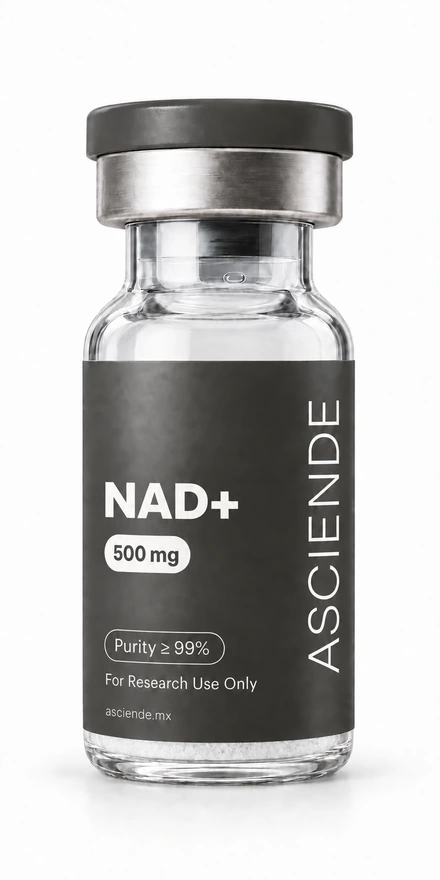
Your selected presentation
Availability to be confirmed · SKU NAD-500
For laboratory research only. Not for human or veterinary use.
Delivery in MexicoFree from $2,500 MXN. Shipping terms
Shipping protectionReport damage with photos within 24 hours of delivery for one replacement. Conditions
Order summaryPrices in MXN. Cart and checkout are in Spanish; review discounts, shipping and the total before paying.
About this compound
The NAD+/NADH pair defines the redox state of numerous enzymatic reactions in cellular models. Its consumption by sirtuins links the cofactor to protein deacetylation pathways.
Read the complete research referenceBatch documentation
Ask support which documents are available for the selected variant and batch. Catalog specifications do not establish an individual batch result.
Review documentation informationResearch context & mechanism
The NAD+/NADH pair defines the redox state of numerous enzymatic reactions in cellular models. Its consumption by sirtuins links the cofactor to protein deacetylation pathways.
Technical specifications
Reference specifications describe the material. They do not replace the analytical results for a specific batch.
- Chemical name
- beta-Nicotinamide adenine dinucleotide
- Sequence
- Not available
- Molecular formula
- C21H27N7O14P2
- Molecular weight
- 663.43 Da
- CAS number
- 53-84-9
- Form
- Lyophilized powder
- Appearance
- White to off-white powder
- Purity specification
- Declared in the batch certificate
- Identity
- Declared in the batch certificate
- Solubility
- Soluble in sterile water and bacteriostatic water
- Storage
- −20 °C, protected from light
- Stability after reconstitution
- Keep refrigerated at 2–8 °C and use within the period defined by the laboratory protocol
Batch documentation
Review documentation for the product and variant you are purchasing. A reference specification, a research publication and an individual batch certificate are different sources. Ask support which documents are available for your chosen variant and batch. No analytical result should be assumed from a catalog specification.
Consult batch certificates How to read documentationLaboratory handling
- Reconstitution
- Laboratory procedure: allow the closed vial to reach room temperature, disinfect the septum and slowly transfer the diluent against the inner wall of the vial. Do not shake; gently swirl the vial until fully dissolved. Record the volume, diluent and date in the batch log.
- Storage
- Sealed vial of lyophilized material: store at −20 °C, protected from light and moisture. Avoid repeated freeze-thaw cycles of reconstituted material; aliquot when the experimental design permits.
- Protective equipment
- Handle in a clean work area with a lab coat, nitrile gloves and eye protection. Dispose of vials, tips and sharps according to the laboratory waste procedure.
Research references
- NAD+ metabolism and its roles in cellular processes during ageing.
Nat Rev Mol Cell Biol · 2021 · PMID 33353981
- Regulation of and challenges in targeting NAD+ metabolism.
Nat Rev Mol Cell Biol · 2024 · PMID 39026037
- Evaluation of safety and effectiveness of NAD in different clinical conditions: a systematic review.
Am J Physiol Endocrinol Metab · 2024 · PMID 37971292
- Nicotinamide Adenine Dinucleotide Augmentation in Overweight or Obese Middle-Aged and Older Adults: A Physiologic Study.
J Clin Endocrinol Metab · 2023 · PMID 36740954
Frequently asked questions
How is NAD+ supplied?
NAD+ is supplied in a sealed vial containing the quantity indicated for the selected variant, with its batch identifier printed on the label.
How is NAD+ stored in the laboratory?
Store the closed vial at −20 °C, protected from light and moisture. See the laboratory handling section of this page for the complete procedure.